 On view at Jessica Silverman through February 28, Rebecca Manson’s “Time, You Must Be Laughing” features porcelain “smoosh”-built butterfly wings that blur the boundaries between painting, sculpture, and craft.
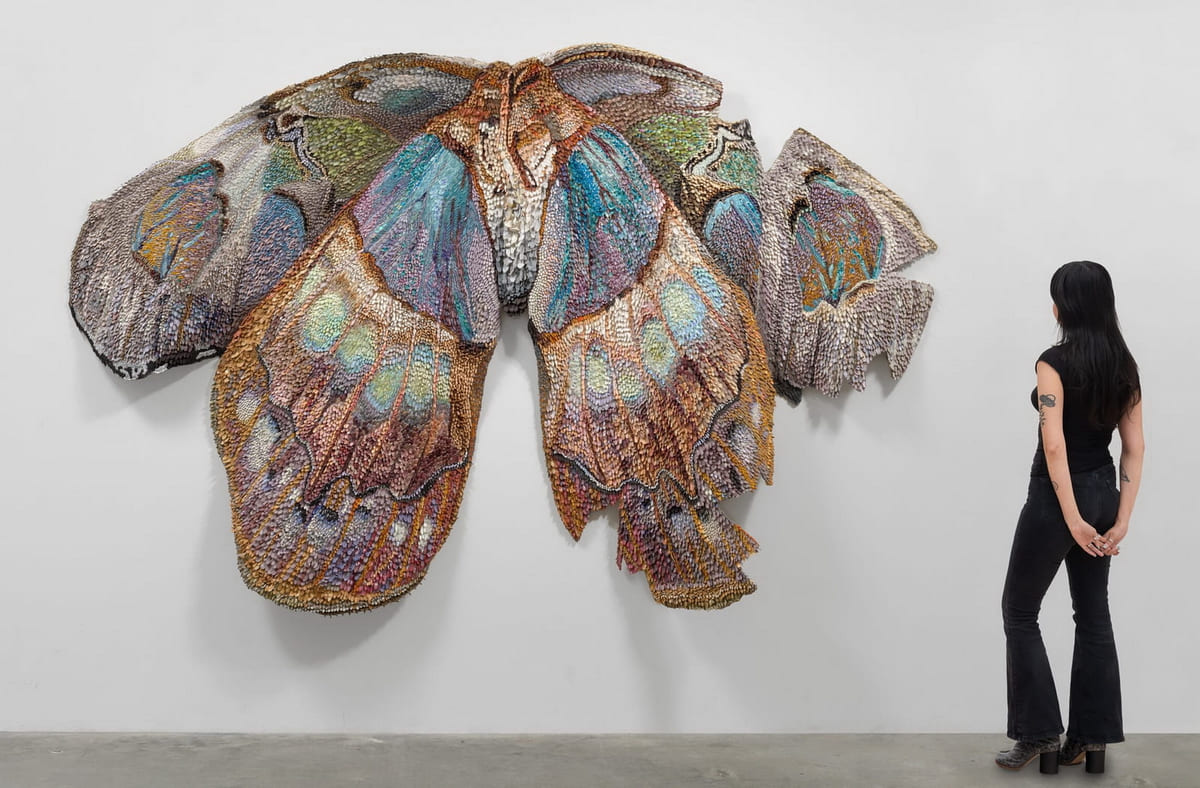
On view at Jessica Silverman in San Francisco through February 28, “Time, You Must Be Laughing” presents a focused look at Rebecca Manson’s evolving practice. The most striking element of the exhibition is a series of human-scale butterfly and moth wings, mounted on walls or placed on floor pedestals.
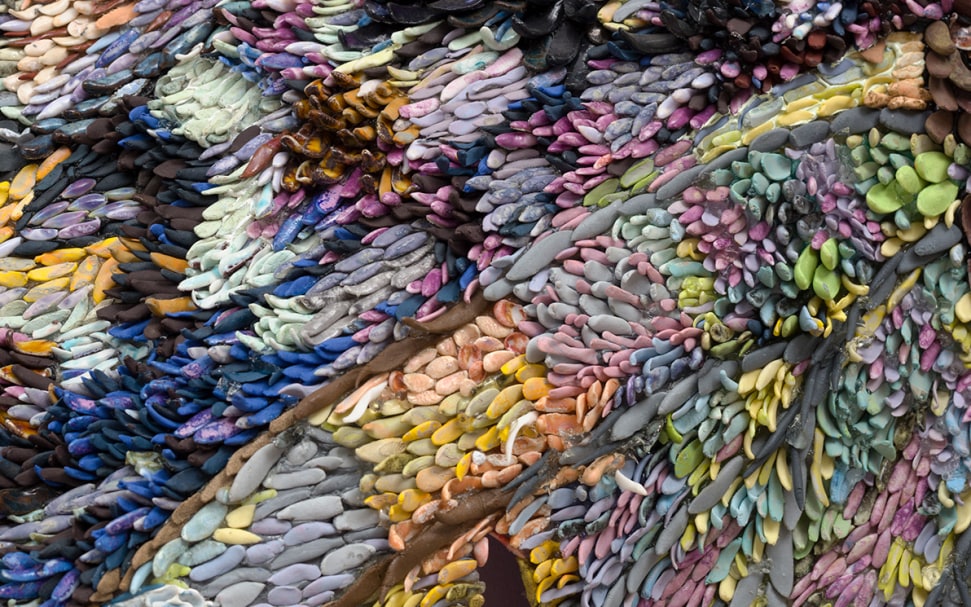
At first glance, the wings captivate with their intricate patterning. A closer look reveals that their surfaces are constructed as mosaics, composed of small porcelain elements the artist calls “smooshes.” While some resemble elongated sunflower seeds in size and shape, they resist the uniformity associated with traditional tesserae. Instead, the smooshes vary widely: some look like torn strips of tape, others like curled ribbons, and some appear as circular disks painted with concentric rings.
Many of these elements carry different colors on each side or display a mottled, molted effect produced through multiple rounds of glazing and firing. Certain pieces feature ridged patterns that echo, on a smaller scale, the vein-like structures of the wings themselves. Despite these internal references, regularity is consistently avoided.
The placement of the smooshes reinforces this sense of intentional inconsistency. Some are attached with their broad faces downward, others balanced on their narrow edges. Often, the end closest to where the wing would connect to the insect’s body is positioned lower than the opposite end, yet numerous variations occur, including completely flat applications.
Color distribution is equally irregular. In repeated eyespot motifs, for example, the lighter central circle shifts subtly from one instance to another. Many Lepidoptera-based works depict a single wing; in some cases, only a fragment is presented. When multiple wings appear together, symmetry in both shape and coloration is notably absent.
Holes, tears, and ruptures punctuate the surfaces. The wings never lie flat; instead, they ripple like waves, curl at the edges, or bend outward into space. The result is a form that feels simultaneously fragile and animated.
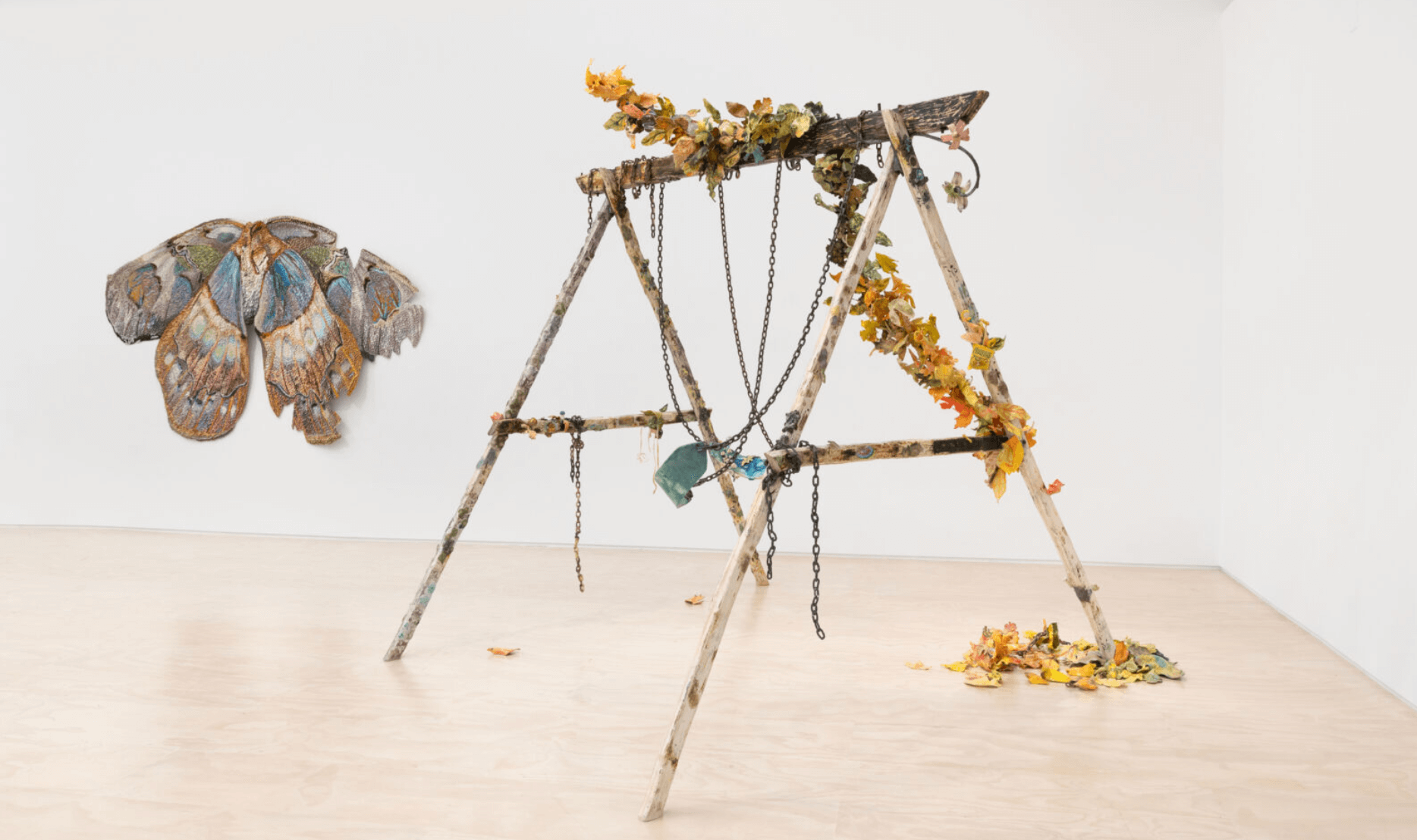
The exhibition also includes non-insect works, notably a life-size swing set sculpture and oversized, weathered flower forms. The swing set, adorned with swooping dried-leaf elements and a bikini detail, appears caught in motion. The chains and seats twist as if stirred by wind or, as scholar Jenni Sorkin suggested during an artist talk, perhaps ridden by invisible, ghostly children.
Notably, the smoosh-based assembly method is unique to the Lepidoptera wing works. These pieces stand apart within the exhibition due to their heightened ambiguity. Detached from any insect body, the wings do not function as portraits. At the same time, their diversity and irregular arrangement prevent them from reading as scientific specimens or catalog entries.
What, then, are these works?
Although constructed like mosaics, the irregularity and gestural accumulation of the smooshes evoke brushstrokes when viewed from a distance, lending the wings the appearance of paintings. Yet their three-dimensional presence and in some cases, freestanding installation asserts their sculptural nature. Given their ceramic medium, they also resonate within craft traditions, though they serve no practical function.
A defining aspect of the wing works is their emphasis on the handmade and the studio labor embedded within them. Each piece originates from sketches and is painstakingly assembled, foregrounding process in a cultural landscape often dominated by concept-driven and mechanically produced art. In this sense, the works recall workshop traditions and even large-scale mural production.
The wings’ deliberate messiness and their refusal to adopt a clear representational or functional purpose prevent them from slipping into kitsch. While visually seductive, they do not romanticize nature nor elevate it into transcendence.
Their closest antecedent, at least in spirit, might be fragmentary notebook drawings from art school exercises involving microscopic study of biological specimens observational, attentive, yet grounded.
Rather than aspiring to the sublime, Manson’s Lepidoptera-inspired works remain firmly anchored in material reality. They suggest something direct and unembellished: this is what is here. No more, no less.