The latest exhibition by Miryam Haddad offers a powerful visual experience that deliberately blurs the boundaries between figuration and abstraction on the pictorial surface. Her canvases are shaped by chromatic and gestural interventions that disrupt traditional systems of representation, inviting viewers into a space where images continuously emerge and dissolve.
Across each surface, one senses human, animal, and vegetal forms faces, birds, vertical signs of rootedness, and interlinked limbs. Yet none of these elements settle into fixed identities. While the visual memory of the statuary of Palmyra resonates within the work, Haddad consciously avoids depicting any specific object. Figures appear caught within the movement of color and matter, only to dissolve back into the surface.
In the first section of the exhibition, thick layers of oil paint and striking color contrasts create a sense of physical intensity. Rather than seeking harmony, colors collide reds and oranges confront blues and greens, amplifying retinal effects. Porte 1 (Door 1) stands out as one of the most vivid examples of this tension.
Composed of nine canvases, the series does not form a unified system but instead unfolds as a kind of visual dramaturgy. Early works present more visible, almost carnivalesque figures, while later surfaces dissolve these forms, erasing spatial and narrative hierarchies altogether.
Haddad’s gestures at times appearing as if carved into the surface with almost athletic force may briefly suggest anatomical elements, yet they quickly transform into autonomous signs. At this point, painting begins not to represent, but to “write.”
Writing plays a central role in Haddad’s practice. However, rather than conveying meaning directly, it is distorted and transformed by paint. Moving away from the decorative aspects of Arabic calligraphy, the artist treats writing as a pure element of movement and rhythm.
The exhibition is rooted in a poetic impulse, particularly inspired by Mahmoud Darwish’s poem On a Canaanite Rock at the Dead Sea. Themes of exile and loss of territory are present, yet they do not translate into direct narrative. Neither the poem nor the paintings aim to deliver a clear message or complaint; instead, meaning unfolds indirectly through sensory impressions.
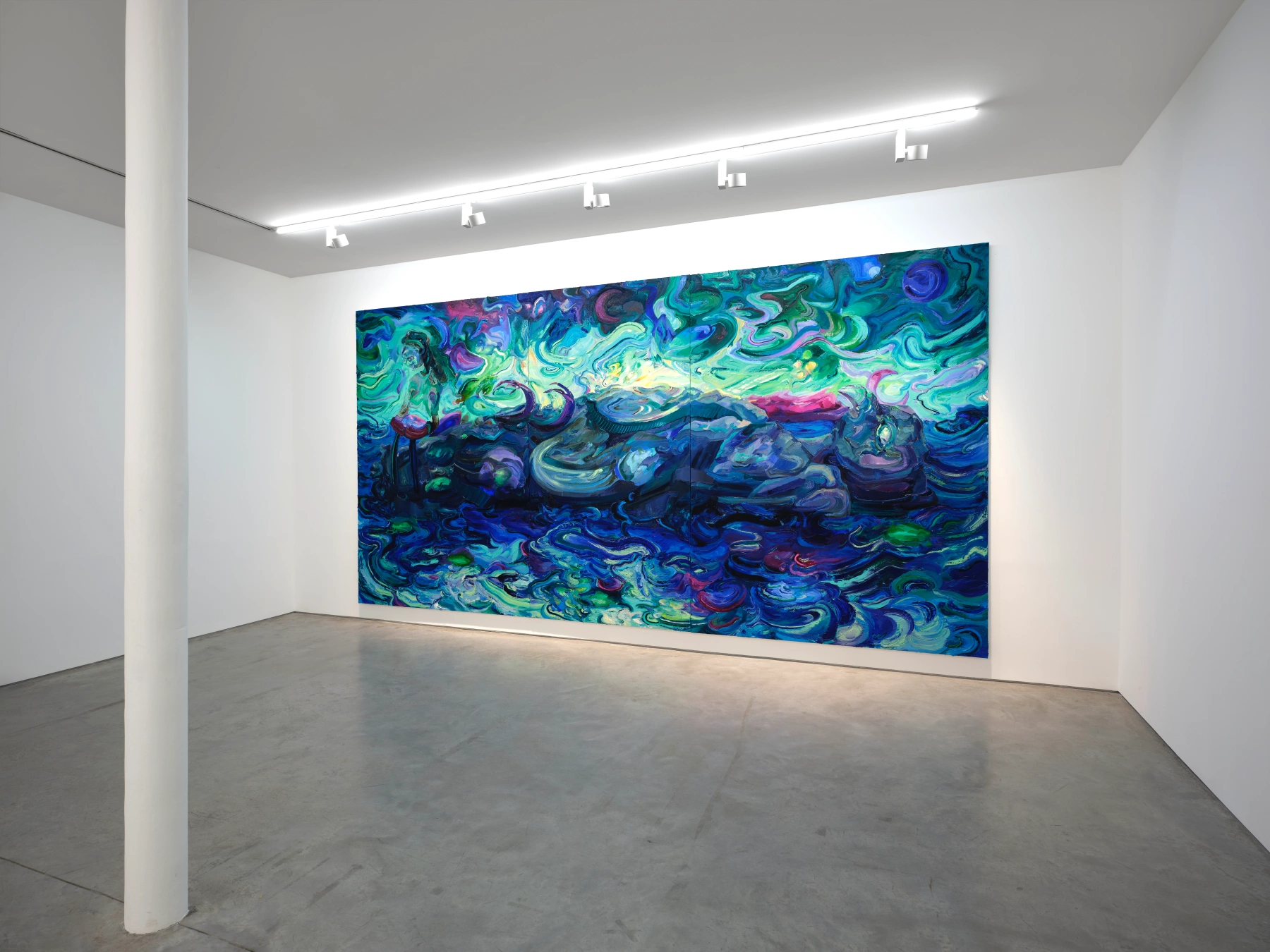
The second section of the exhibition introduces a shift in spatial dynamics. On one side, the small-scale Graines (Seeds) series offers intimate microcosms that require close viewing. On the other, the monumental canvas Le sel d’un songe (The Salt of a Dream) envelops the viewer in what feels like a disrupted horizon or a sky crossed by solid waves.
Faced with this large-scale work, the viewer experiences a deliberate sense of disorientation. From a distance, figures re-emerge a tilted head, a torso, joined arms, even bird-like forms yet without defined contours, they remain captive within the movement of the surface.
Haddad’s practice moves beyond the traditional Western debate between abstraction and figuration. While echoes of deformation recall artists such as Jean Fautrier and Jean Dubuffet, Haddad establishes her own tension: neither image nor painterliness dominates either both coexist, or neither prevails.
The intensity of color suppresses emotional pathos, while the fragmentation of images is counterbalanced by the movement of matter. The result is an almost magnetic chromatic field that collides with the viewer’s sensory perception. In this sense, painting is not merely seen it is experienced, even transformative.
Within this exhibition, text, fragments of figures, and the viewer’s gaze continuously shift across layers of density. What emerges is a deeply human condition: a tension between distance and immersion, between rational clarity and sensory submersion.
Haddad’s paintings exist in a paradox they are both hallucinatory and materially present. The figures that inhabit the surface do not explain; they leave traces. In doing so, they bring both external and internal conflicts back into view.
Ultimately, the exhibition pushes viewers beyond their comfort zones, offering an intense experience that challenges perception and opens new ways of seeing.