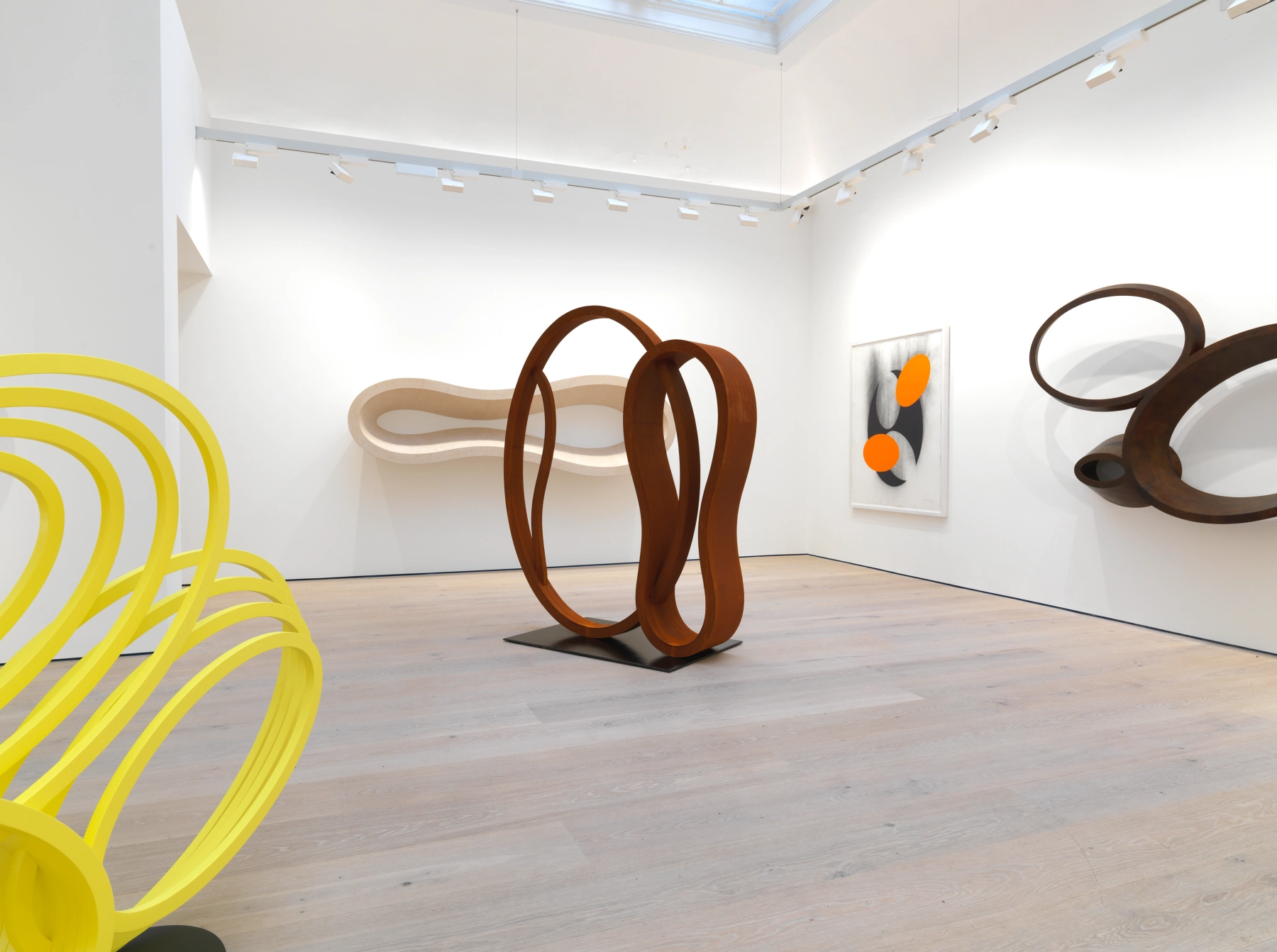
Nigel Hall’s exhibition “My Choice” presents a carefully curated selection of works chosen by the artist himself, tracing the evolution of his practice from the mid-1960s to the present day. Hosted by Annely Juda Fine Art, this marks Hall’s thirteenth solo exhibition with the gallery, continuing a long-standing collaboration that began in 1978.
Originally rooted in landscape, Hall’s practice has consistently drawn inspiration from the natural world. Rather than depicting specific locations, his work evokes the memory and sensation of being within a space. Through abstract and geometric forms, he distills the essential and elemental qualities of landscape. As Hall notes, his work has always been about place, driven by a fascination with how geometry can be perceived within natural environments.
Working across both two-dimensional and three-dimensional media, Hall explores the dynamic relationship between mass and void, presence and absence. In his sculptures crafted from materials such as steel, aluminium, bronze, and birch plywood empty space is not passive but actively shaped and enclosed, becoming as significant as the solid forms themselves.
Drawing plays an equally vital role in Hall’s artistic process. His works on paper, often developed using charcoal and color, reveal a slow and layered approach. Traces of preliminary marks remain visible, grounding the composition, while the depth of black emerges through repeated applications. Color, in turn, reflects both emotional tone and experimental exploration.
A central aspect of Hall’s work is its ability to transform the viewer’s perception of space and volume. As one moves around his sculptures, the relationship between form, scale, and environment shifts continuously. This sensitivity to human perception our awareness of distance, balance, and the vertical and horizontal axes within space runs throughout his oeuvre.
The exhibition opens with an early figurative piece, Lone Figure with Balloon (1965), created during Hall’s time at the Royal College of Art in London. The rhythmic interplay between the figure and the tethered balloon introduces an early exploration of duality a theme that would become central to his work. By the 1970s, Hall’s practice evolved toward abstraction, producing geometrically defined wall sculptures that engage both the physical surface and the spatial dimensions created by painted aluminium elements.
A key example from this period, Black Shoal (1982), reflects the artist’s observation of natural movement, subtly referencing the shifting formations of fish shoals. By the mid-1990s, Hall expanded his sculptural language with birch plywood constructions, introducing more fluid, curvilinear forms. This period also marked a renewed interest in the ellipse, a motif first explored in his 1968 work Soda Lake. These forms rounded, paired, and doubled suggest complementary forces such as emptiness and solidity, stillness and motion, unified within a single structure.
Works from later decades continue to develop these core ideas, incorporating new materials and processes. Color and materiality take on increasing importance, emphasizing the intrinsic qualities of each form and enhancing the dialogue between structure and perception.
The exhibition culminates in two recent large-scale sculptures presented in the main gallery space: Concavities (2025), a vivid yellow aluminium work exploring concentric elliptical forms, and String Section II (2026), a two-meter-high Corten steel sculpture characterized by flowing, undulating volumes that echo rhythmically through space.
Nigel Hall has exhibited extensively both in the UK and internationally. His career includes major solo exhibitions at institutions such as Towner Gallery in Eastbourne, Yorkshire Sculpture Park, and the Royal Academy in London, alongside international presentations in Paris, Zurich, Mannheim, and Madrid. His works are held in leading public collections worldwide, including Tate, MoMA, the Art Institute of Chicago, the British Museum, and the Musée National d’Art Moderne in Paris.
Born in Bristol in 1943, Hall studied at the West of England College of Art and the Royal College of Art in London. A Harkness Fellowship took him to the United States between 1967 and 1969. His accolades include the Pollock-Krasner Award (1995) and the Jack Goldhill Sculpture Prize at the Royal Academy (2002). He later served as Head of MA Sculpture at Chelsea School of Art and was elected a Royal Academician in 2003. In 2017, he was awarded an Honorary Doctorate from the University of the Arts London.