From roughly 2010 until early 2022, the art market was discussed not only in terms of aesthetics and cultural value, but also as a vehicle for financial return. Demand around emerging artists, crowded opening nights, waiting lists filled before works were even seen, and the NFT boom during the pandemic all symbolized a period in which art functioned as a speculative asset. The market has since cooled. Speculation, however, has not disappeared it has simply migrated.
Today, one of the fastest-growing trends globally is the rise of prediction markets. On these platforms, users can take positions on political elections, geopolitical developments, celebrity behavior, and pop culture events. As long as an outcome can be framed in binary terms—yes or no it can be transformed into a financial contract.
How Prediction Markets Work
One of the most prominent platforms in this space is Polymarket, founded in 2020. Users purchase “event contracts” priced between $0.01 and $1, betting on whether a specific outcome will occur. When you buy a contract, you are effectively taking the opposite side of another user’s position; you are not betting against the house. The platform earns revenue through transaction fees.
Prices fluctuate in real time based on supply and demand. For example, if a user buys a “yes” share at $0.20 and the predicted outcome occurs, the contract settles at $1, generating $0.80 in profit. If the outcome does not occur, the share becomes worthless. Because regulatory oversight is relatively limited, concerns about insider information and market manipulation have emerged. Critics argue that reality itself risks becoming a derivative product.
Where Is Culture?
Interestingly, the “culture” category on such platforms rarely includes what the art world traditionally considers culture. While users actively wager on music performances, social media activity, and celebrity appearances, million-dollar paintings, museum exhibitions, and major art events are largely absent.
This is notable given that between 2010 and 2019, the art market experienced significant financialization. Third-party guarantees, short-term resale strategies, rapid price increases between primary and secondary markets, and the rise of art funds turned artworks into quasi-financial instruments. During the pandemic, the NFT surge intensified this trend. Major auction houses such as Sotheby’s and Christie’s quickly adapted to digital assets.
At the height of the NFT boom, projects like Bored Ape Yacht Club and CryptoPunks appeared sporadically on prediction platforms. However, this attention proved short-lived.
The 2025 Leonard Lauder Sale: A Turning Point?
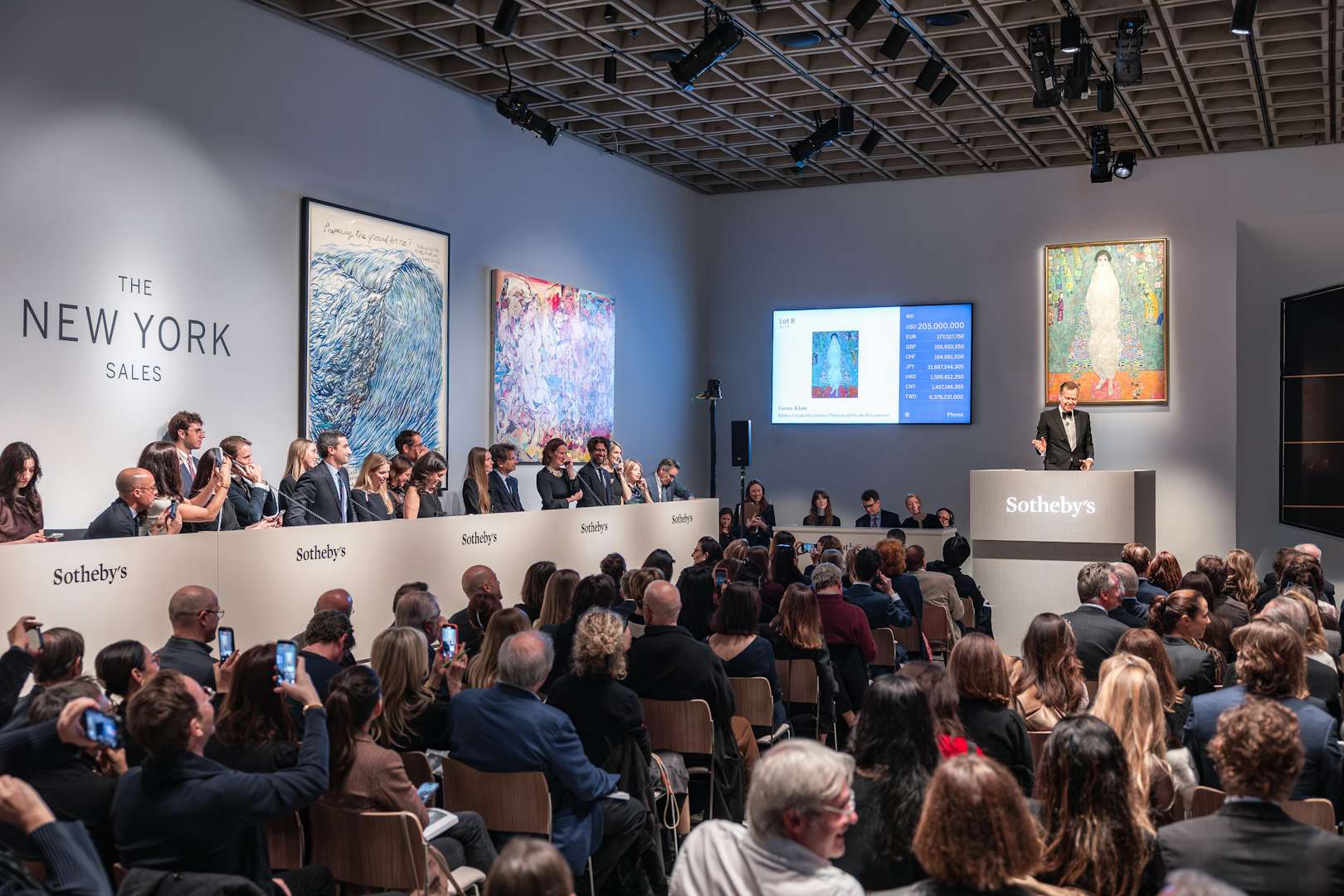
A rare and significant intersection between prediction markets and the art world occurred with the 2025 sale of the Leonard Lauder collection. The Estée Lauder heir’s works were auctioned by Sotheby’s at its Breuer building in New York. In a single evening, 24 works generated more than $527 million.
The standout result was Gustav Klimt’s Portrait of Elisabeth Lederer, which sold for $236.4 million ranking among the highest prices ever achieved for a modern artwork at auction.

Sotheby’s auctioneer Ollie Barker at the sale of the Leonard Lauder collection. Courtesy Sotheby’s
On Polymarket, this event generated approximately $1.4 million in betting volume. Thirteen of the works were listed as prediction contracts. Users did not merely speculate on hammer prices; they also debated auction mechanics such as the buyer’s premium. This moment signaled the potential viability of a derivatives-style market built around art auctions.
Insider Information and Ethical Risks
The art world has long operated through tightly networked information channels. Knowledge about which artist is poised for a breakout or which major collection is coming to market often circulates within select circles. When such dynamics intersect with prediction markets, the risk of insider trading becomes significant. Similar concerns have already surfaced in political betting markets.
2026 and Beyond: Biennials and Cultural Derivatives
Looking ahead, major auction houses are expected to continue organizing high-profile single-owner sales. At the same time, global art events could become subjects of prediction contracts. For instance, speculation surrounding awards at the Venice Biennale—such as the Golden Lion no longer seems implausible.
Meanwhile, technology and venture capital circles interpret this shift as part of a broader cultural transformation. At Andreessen Horowitz, Alex Danco has described “prediction” as a new meta-aesthetic paradigm, comparable in significance to modernism or postmodernism. In this view, making predictions becomes a new form of producing knowledge.
A New Phase: Speculation Without the Object
In the 2010s, the artwork itself was financialized. In the emerging model, the event surrounding the artwork may become the financial instrument. Rather than purchasing a painting, one might speculate on the price it will achieve. The physical object becomes secondary to the probability attached to it.
The decline of overt art flipping was not primarily the result of moral or intellectual reform, but of shifting market conditions. The rise of prediction markets suggests that speculative energy has not vanished it has found a new orientation.
For years, the art world has debated participation, access, and ownership in cultural production. Prediction markets may appear to broaden participation, but the quality and consequences of that participation remain open questions.
The financialization of art over the past decade may, in retrospect, have been a rehearsal. The next phase could involve not the artwork itself, but the outcomes, events, and expectations surrounding it becoming tradable assets. Whether this shift proves lasting will depend on how markets and culture choose to respond.