Torn plush toys, aggressively spreading kudzu vines, and mounds of earth shaped into deity-like figures have all surfaced in Okoyomon’s practice, which has been exhibited at institutions spanning from the Venice Biennale to the Palais de Tokyo. As the artist explains, a central thread uniting their work is an ongoing exploration of violence and healing. “Much of what I create comes from constant processing,” Okoyomon noted. “As Adam Phillips suggests, we never truly outgrow the masochism rooted in childhood and that resonates deeply.”
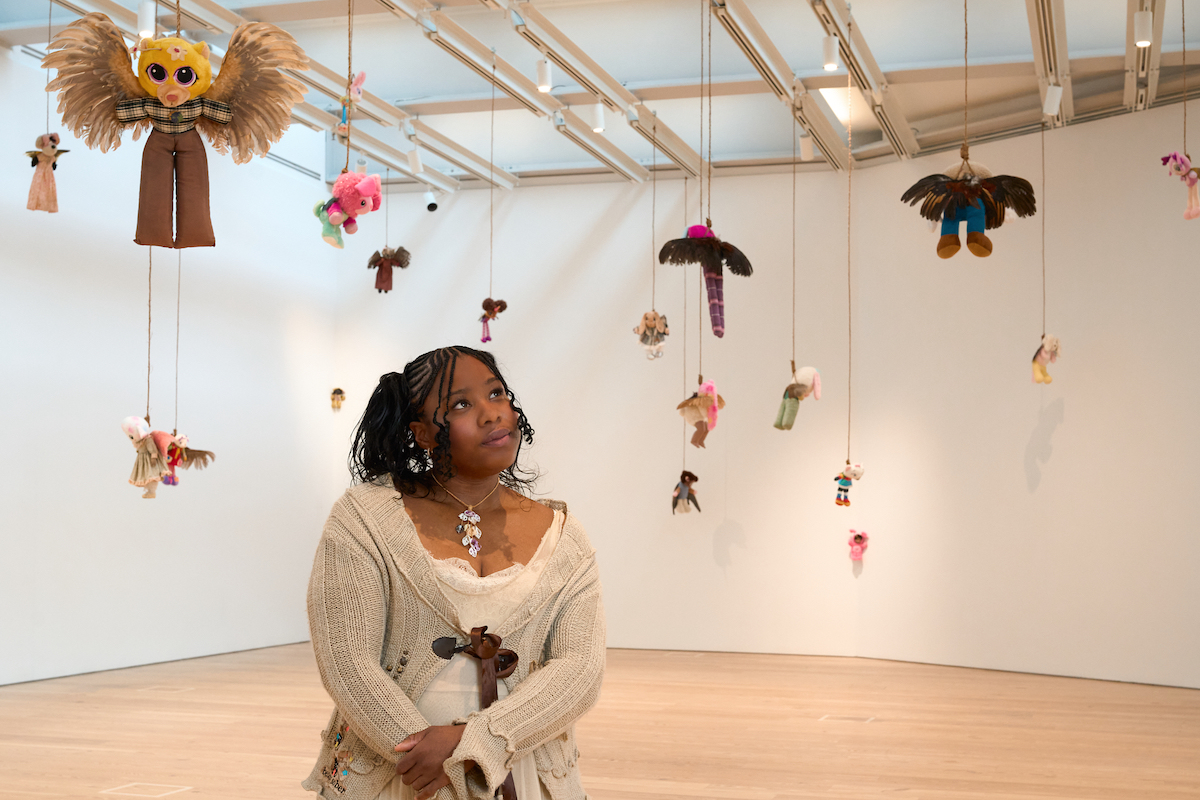
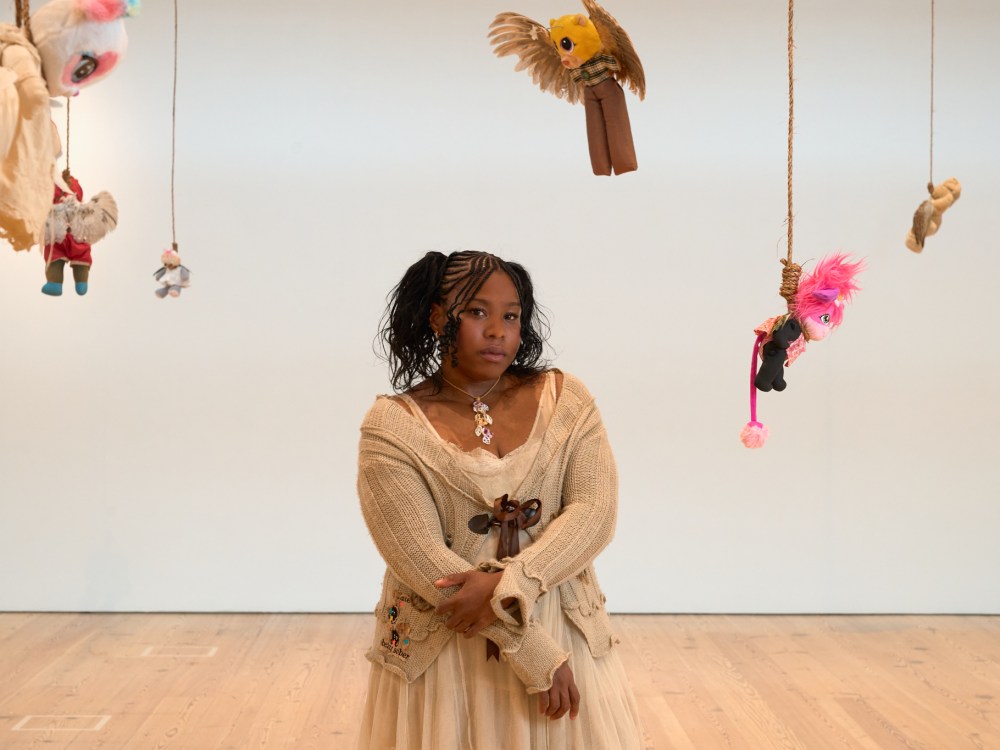
Some of the stuffed animals featured in the Whitney installation once belonged to Okoyomon, while others were sourced secondhand from the Midwest, where the artist grew up. The dolls, on the other hand, were acquired from an Astoria-based antiques dealer whose collection, in Okoyomon’s words, includes “strange, almost cursed” objects. Combined with taxidermy feathers taken from deceased pets by a friend, these elements come together to form a deeply unsettling installation one that reflects the small, persistent eruptions of violence embedded in everyday life. Echoing this theme, Okoyomon has cut apart and reassembled the plush toys and dolls, transforming them into hybrid, otherworldly figures.
Known for weaving philosophical references into their work, Okoyomon described the sculptures as existing in “a suspended state of transcendence.” They posed a question: “What does it mean to be an angel in the Miltonian sense? An angel cannot be killed, nor can the force that holds it down be destroyed.” The artist added that they are continually questioning whether their work can ever be separated from the self, or from the ongoing, relational violence tied to Blackness in daily life.
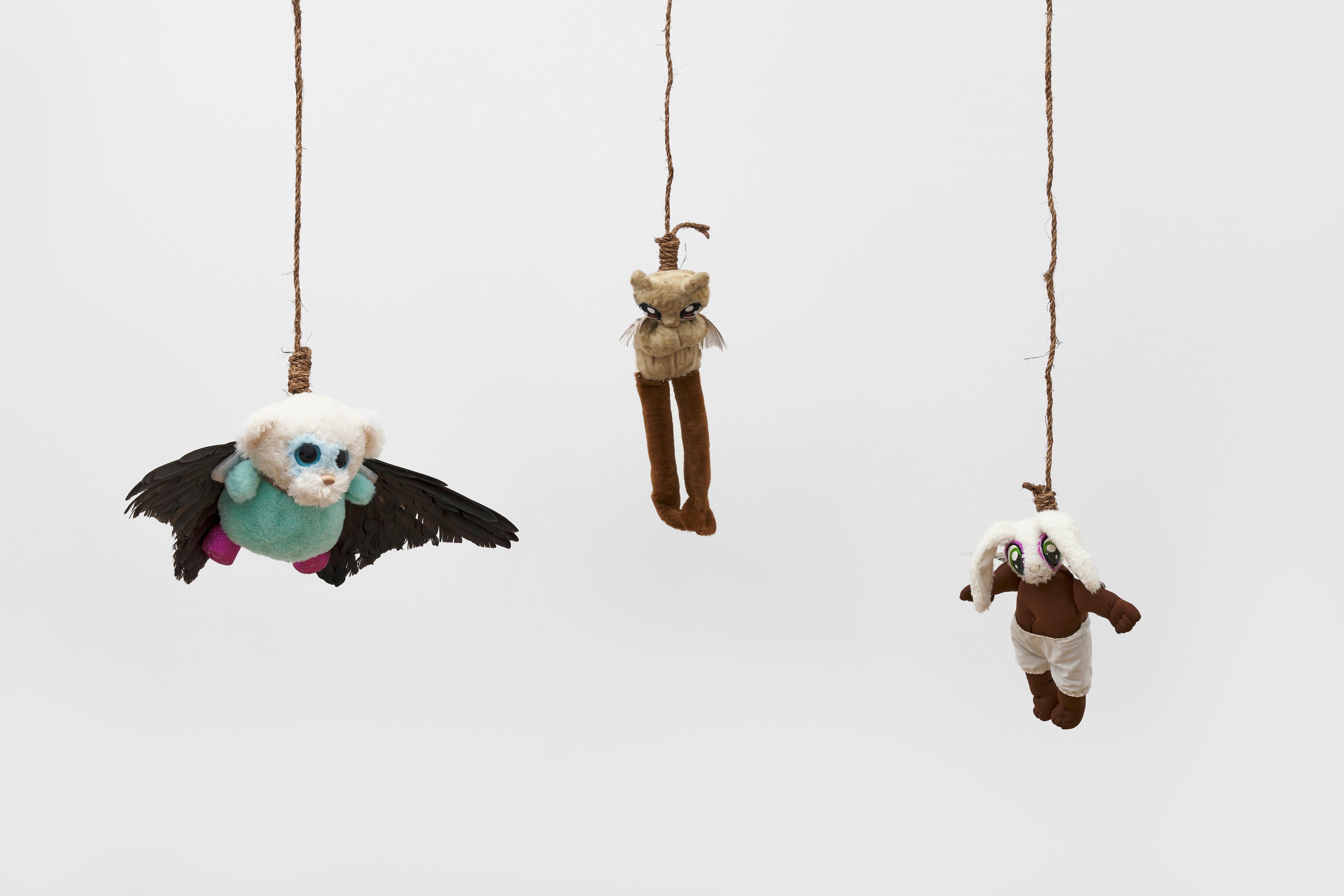
Drew Sawyer, who co-curated the Whitney Biennial with Marcela Guerrero, told ARTnews that Okoyomon creates “stunning installations that also carry dark, unsettling narratives.” As an example, he noted that the plush animals in the Whitney show bear signs of wear. “It’s clear they were loved,” he said, “so there’s a very tender aspect. But they’ve been abandoned, and these birds are dead. There’s both grief and violence, and they’re suspended from nooses, which evoke associations such as lynching and suicide.”
https://www.artnews.com/wp-content/uploads/2026/03/New-Museum_New-Humans_0326_0351.jpg?resize=1000,750
Okoyomon’s art often carries a slippery, ominous edge, visible in both their Whitney installation and When the Lambs Rise Up Against the Bird of Prey (2024), currently on view at the newly reopened New Museum downtown. In the New Museum piece, a Black figure wears a sheer white dress topped with animal ears reminiscent of the lacy outfit Okoyomon donned during a previous meeting. The figure gazes straight at viewers before making sudden, jerky motions; it’s an animatronic, though that detail isn’t immediately apparent. The installation sits in a recessed space lined with tufted material. “It’s pink fiberglass insulation,” Okoyomon explained with a laugh. “If you breathe it in up close, it will kill you.” (A museum spokesperson noted that the work is safe for visitors, as it is positioned out of reach in the alcove.)
When asked if the goal was to shock, Okoyomon replied, “It’s not about provocation. I see it as a slow, realignment of everyday desire.”

Precious Okoyomon, in the belly of the sun endless, 2025.
A gardener, poet, and artist, Okoyomon has consistently engaged with the landscapes around them. Born in 1993 in London, they spent their childhood searching for what they called “continuous space,” as their family moved frequently between the UK, Nigeria, and the US. “No matter where we went, there was always semi-nature,” they reflected. “We lived in Texas, then Ohio, where woods were nearby. Sometimes, I don’t fully understand the people around me. Everything seems to be in flux.” Seeking some stability, they developed a deep connection with the earth early on, composing poems that they would bury in the soil.
Okoyomon pursued philosophy at Shimer College in Naperville, Illinois, graduating in 2014, but discovered that their relationship to language differed from most in the field. They continue to see their art and poetry as intertwined. “It’s a relational way of seeing the world,” they explained. “It’s simply witnessing.”
By the late 2010s, as their artistic trajectory accelerated, their projects grew in scale, culminating in 2020 with an exhibition at the MMK Museum in Frankfurt, Germany. Curated by Susanne Pfeffer, one of today’s most acclaimed curators, the show took place before Okoyomon had turned 30 and featured a garden installation dominated by Resistance is an atmospheric condition (2020), a sprawling kudzu work. This invasive plant, brought from Japan to the US, served as a metaphor for Blackness: once it took root, it was hard to contain. By the exhibition’s conclusion, the vines had nearly engulfed several sculptures within the installation. The work was later named among ARTnews’s best pieces of the 21st century so far, making Okoyomon one of the youngest artists to receive such recognition.

Precious Okoyomon, Resistance is an atmospheric condition, 2020.
“I experienced the MMK exhibition, and it completely astonished me,” said curator Cecilia Alemani, who later included Okoyomon in the 2022 Venice Biennale. At the Arsenale, one of the Biennale’s principal sites, Okoyomon presented a striking installation, transforming a space once used for weapons into a lush environment with soil, plants, and live butterflies. “It was a challenge to cultivate a garden in March in Venice inside a 15th-century building. We had to nurture the plants in a greenhouse, and they created sculptures from wool,” Alemani recounted, adding that the kudzu there also risked overtaking the area. She emphasized that Okoyomon’s practice “is not about choosing between nature and humans, or life and death. It’s about embracing hybridity and existing in the spaces between.”

Precious Okoyomon, To See the Earth before the End of the World, 2022.
Okoyomon’s art often captivates with its surface beauty, yet it can conceal unsettling truths beneath. Discussing their Whitney work, Okoyomon observed that the stuffed animals seem to float, likening this effect to white supremacy. “White supremacy is a theft of everyday gravity it stops the sky and the structure,” they explained. Referring again to the stuffed animals, they added, “They’re all fragments of each other. They’re all taken apart.”
On a personal note, Okoyomon shared that they rely on a daily meditation practice to stay grounded. “I’m constantly trying to hack the predictive processing of my brain, just to find some rest,” they said. “I strive to remain in the present, and that takes a lot of effort.”