
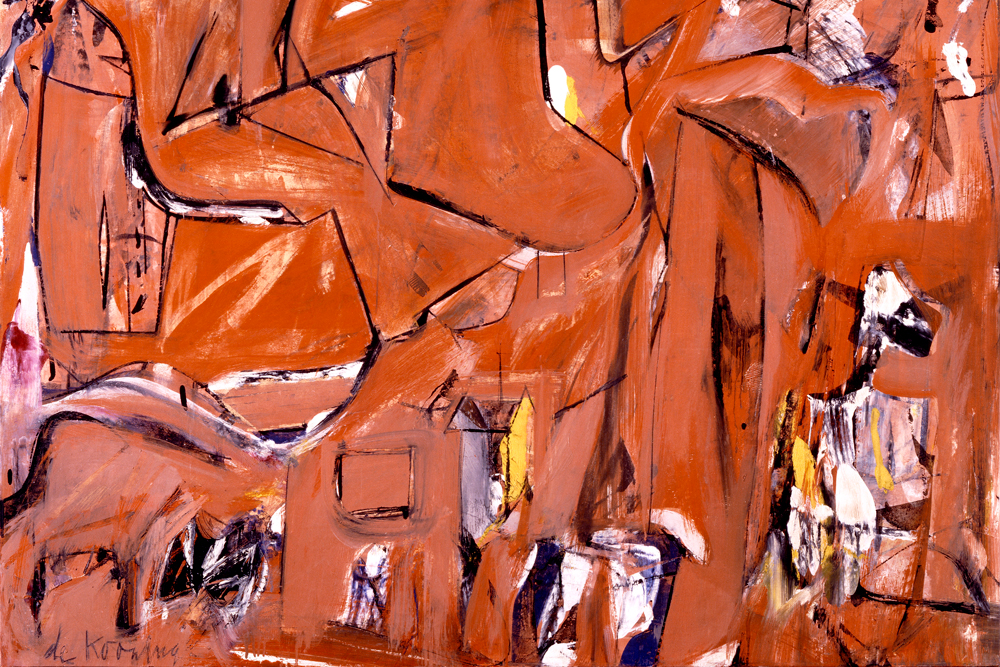
In the narrative of 20th-century art, few moments carry the quiet yet seismic impact of Willem de Kooning’s first solo exhibition in 1948. Held at Charles Egan Gallery, this long-delayed debut did more than introduce a mature artist it signaled a fundamental shift in the trajectory of American painting.
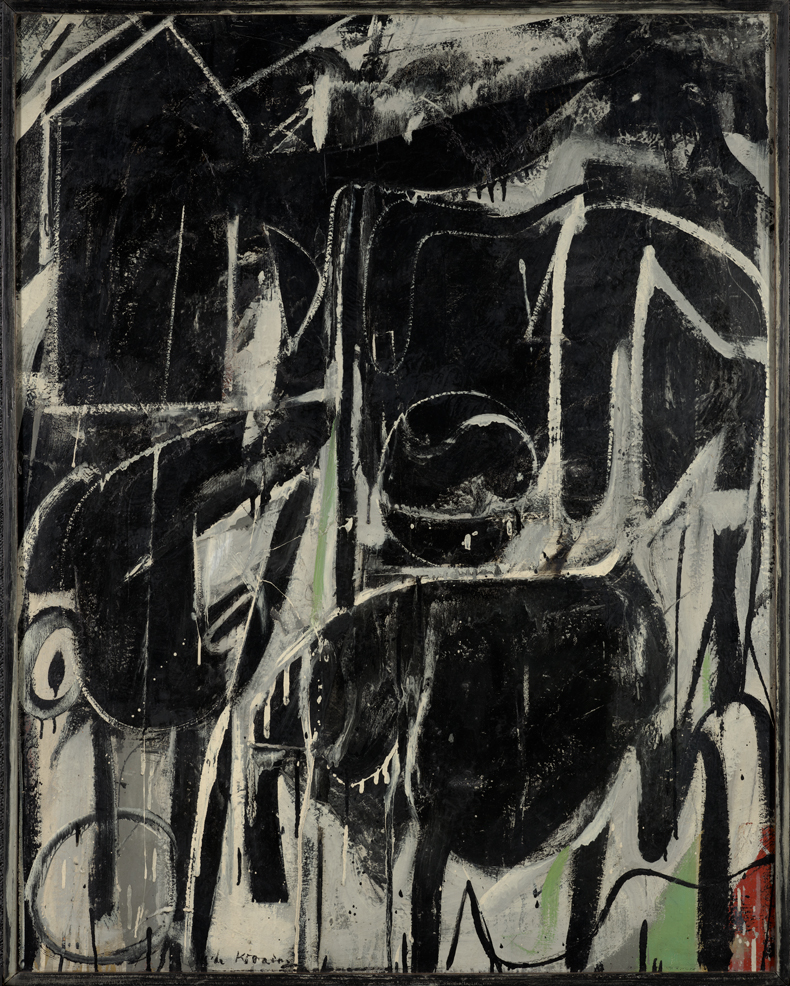
Black Friday (1948), Willem de Kooning. Princeton University Art Museum. Photo: Jeff Evans; © 2026 The Willem de Kooning Foundation/Artists Rights Society (ARS), New York
At 43, de Kooning was far from an emerging talent. For years, he had been deeply embedded in New York’s experimental art circles, working alongside figures who would later define Abstract Expressionism. Yet unlike many of his contemporaries, he resisted early exposure, choosing instead to refine his visual language in relative obscurity. When the exhibition finally opened, it was immediately clear that this was not a beginning, but an arrival.
Critic Clement Greenberg recognized this instantly, writing that de Kooning appeared “in full maturity.” His assessment underscored what many saw in the works: a rare command of composition, gesture, and material. De Kooning’s paintings revealed an artist who had already resolved many of the formal questions that others were still grappling with balance versus chaos, structure versus spontaneity, figure versus abstraction.
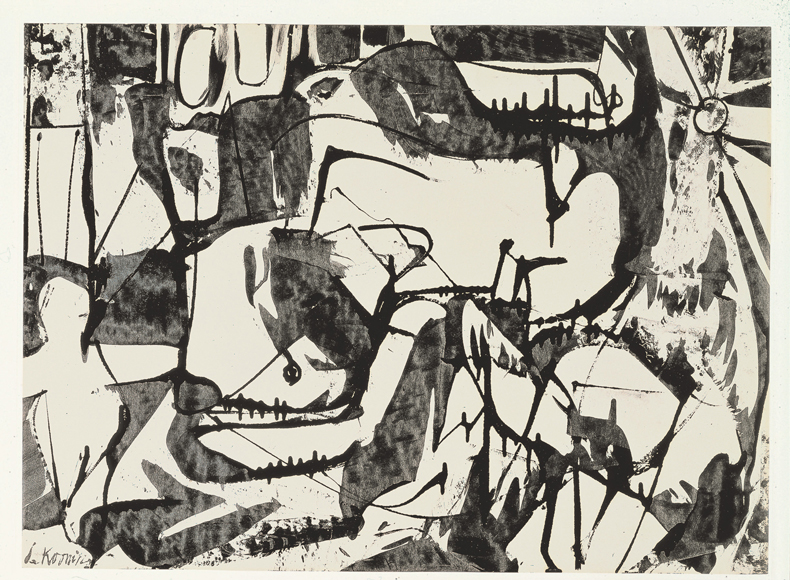
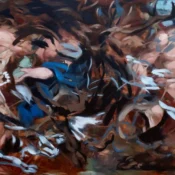
Untitled (Black and White Abstraction) (1950), Willem de Kooning. Private collection. © 2026 The Willem de Kooning Foundation/Artists Rights Society (ARS), New York
The exhibition featured a body of work that was largely abstract, executed in oil and enamel on canvas. These paintings were not passive surfaces but arenas of action dense with movement, tension, and layered revisions. Unlike the expansive color fields that would later define some of his peers, de Kooning’s canvases felt urgent and tactile, built through scraping, overpainting, and reworking.
While the influence of European modernists such as Henri Matisse and Joan Miró is evident in his use of color and abstraction, de Kooning’s approach diverged sharply in its physicality. His aggressive brushwork and insistence on reworking the canvas introduced a new intensity into American painting. Particularly notable was his use of black not as absence, but as a structuring force that anchored and disrupted the composition simultaneously.
Another defining aspect of de Kooning’s practice was his resistance to finality. He rarely dated his works and often revisited them months or even years later. Paintings were never truly “finished” in his eyes. This open-ended approach was both a philosophical stance and a working method, reflecting a belief that art should remain alive and in flux. It was frequently Elaine de Kooning his wife and a formidable artist in her own right who ultimately intervened, declaring works complete and assigning titles to them.
This fluidity presents challenges for art historians attempting to map his evolution during this critical period. However, it also offers insight into the very essence of his practice: a continuous negotiation between control and uncertainty.
The timing of the 1948 exhibition is equally significant. In the aftermath of World War II, New York was rapidly emerging as a new center of the global art world, gradually displacing Paris. De Kooning’s work, along with that of his contemporaries, played a crucial role in this transformation. His ability to synthesize European influences with a distinctly American energy helped define a new visual language that would dominate the postwar era.
Running from March 15 to July 26, this exhibition revisits that pivotal moment, emphasizing its lasting impact. It not only solidified de Kooning’s position within the avant-garde but also contributed to the legitimization of Abstract Expressionism as a major artistic movement on the world stage.
Today, the 1948 show is widely regarded as a cornerstone in modern art history a moment when an artist fully realized his voice and, in doing so, helped redefine what painting could be.


I have the feeling of différent reality and a fresh air