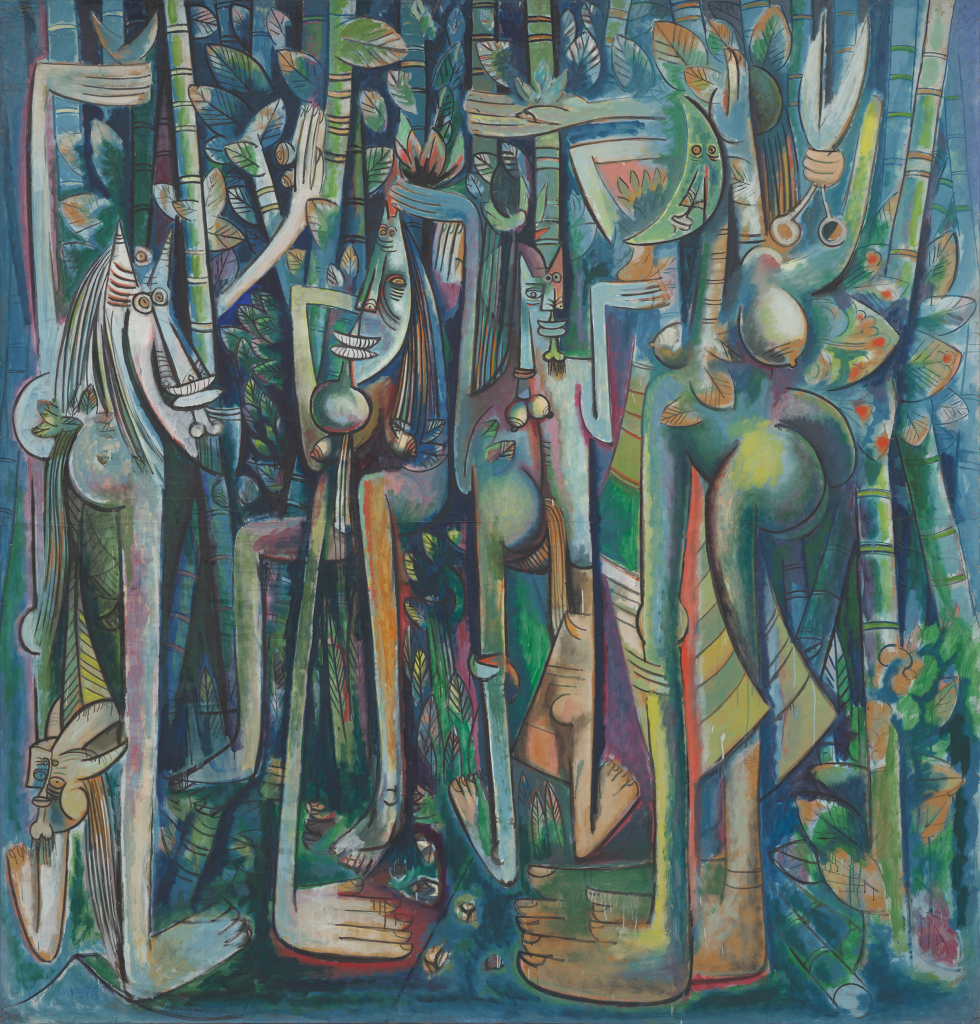
An exhibition of Wifredo Lam at the Museum of Modern Art might seem like a safe institutional choice. Lam is already canonized—his work appears in nearly every major survey of Surrealism, and MoMA acquired his landmark painting The Jungle in 1946, only a few years after it was completed. Yet the exhibition “Wifredo Lam: When I Don’t Sleep, I Dream” does more than restage a masterpiece. It reopens the question of Lam’s place in art history and suggests why his work feels urgently contemporary.
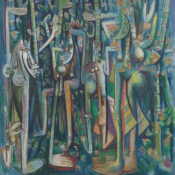
At the heart of the show is The Jungle (1942–43), a dense thicket of elongated, mask-like figures merging human, animal, vegetal, and spiritual forms. It remains one of the most enigmatic paintings of the twentieth century instantly recognizable, yet resistant to definitive interpretation.
Culture Clash: Beyond “Cuba’s Picasso”
Lam’s biography presents an apparent contradiction. He was deeply immersed in European modernism between the wars, yet he later framed his artistic project as a form of cultural decolonization. For decades he was described as “Cuba’s Picasso,” owing to his close friendship with Pablo Picasso and the visible dialogue between The Jungle and Picasso’s revolutionary Les Demoiselles d’Avignon (1907).
But to read Lam merely as applying Cubism to Caribbean themes diminishes the originality of his vision. His work is not derivative Cubism transplanted to the tropics. Nor, however, is it reducible to a single identity category.
In today’s art discourse, the emphasis often shifts toward Lam’s Afro-Cuban heritage and his relationship to Santería, the syncretic religion developed in Cuba by descendants of enslaved Africans. Indeed, his paintings teem with hybrid beings that recall orisha spirits. Yet Lam himself was not a practicing Santería devotee. Though influenced by his grandmother, a priestess, he insisted that his paintings emerged from poetic impulse rather than symbolic illustration.
“I don’t use symbolism,” he once said. “I never invent my paintings in relation to symbolic tradition, but always from a poetic stimulus.”
Lam understood that he risked misunderstanding from multiple audiences European modernists, Cuban traditionalists, and everyday viewers alike. That tension remains part of his work’s power.
Europe, War, and the Surrealist Turning Point
Born in 1902 in Sagua la Grande, Cuba—the year of the island’s formal independence from Spain—Lam grew up at the crossroads of cultures: Afro-Cuban, Spanish, and Chinese. He studied in Havana before receiving a grant to continue his education in Europe.
During his years in Spain, Lam absorbed the legacy of Goya, El Greco, and Bosch at the Prado, while engaging with modernist developments shaped by Cézanne and Cubism. Personal tragedy struck when his wife and child died of tuberculosis. Politically radicalized by the Spanish Civil War, he joined the anti-fascist cause before fleeing to Paris in 1938.
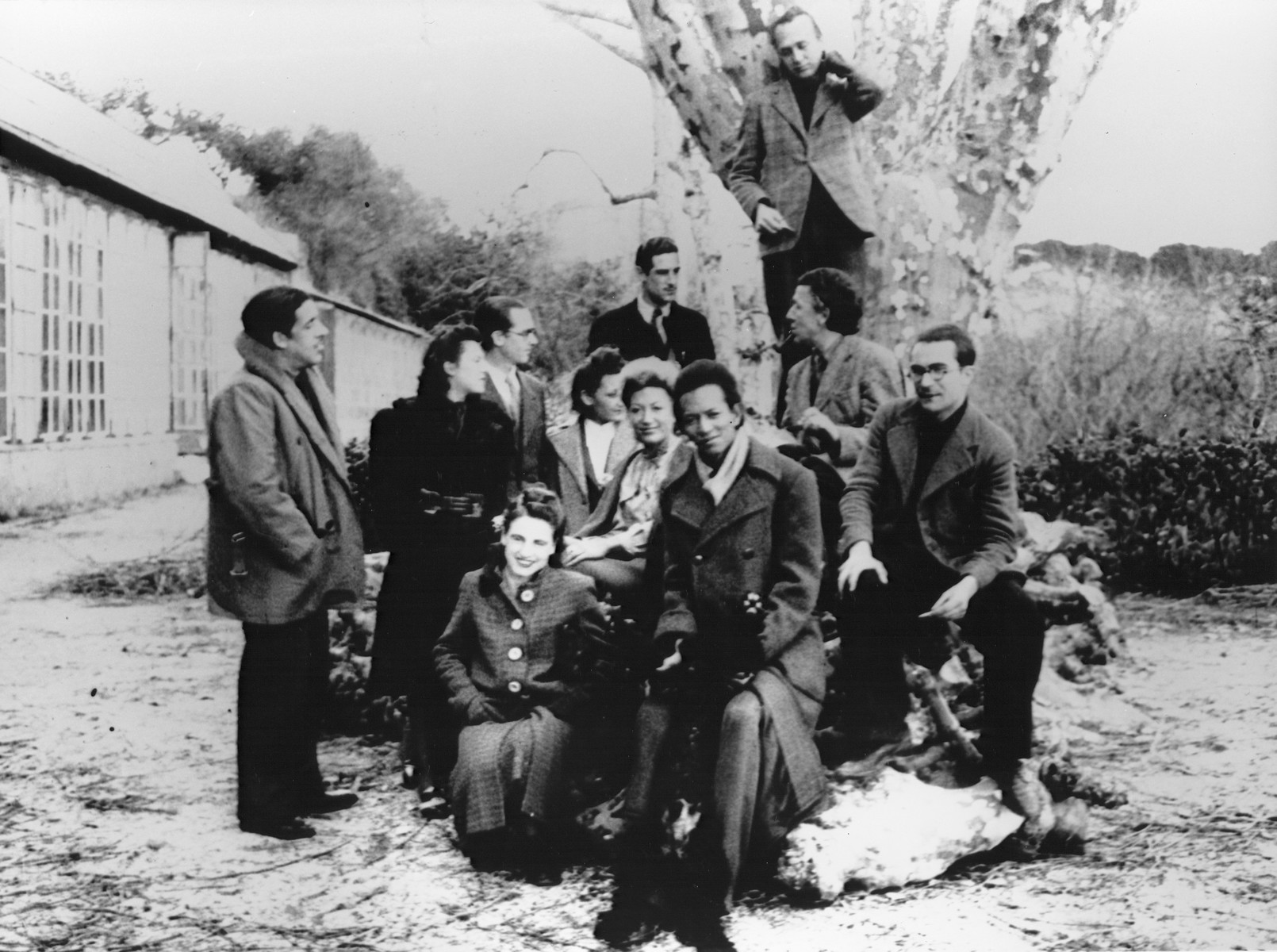
There he met Picasso and entered the orbit of the Surrealists led by André Breton. When the Nazis invaded France, Lam escaped south to Marseille, joining a remarkable circle of intellectual refugees at Villa Air Bel. Among them were Breton, anthropologist Claude Lévi-Strauss, and writer Victor Serge.
In exile, Surrealist experimentation intensified. The group created collaborative games, including the famous “exquisite corpse,” in which multiple artists contributed sequentially to a drawing without seeing the whole. This collective automatism left a lasting imprint on Lam’s imagination.
When Lam eventually returned to Cuba in 1941—after an interlude in Martinique where he encountered poet Aimé Césaire and the Négritude movement—he experienced profound disillusionment with the island’s social realities. Yet that return catalyzed his breakthrough. In Cuba, Lam fused Surrealist automatism with Caribbean spiritual and social consciousness, culminating in The Jungle.
Syncretic Surrealism: More Surreal Than the Surrealists?
Surrealism emerged in Europe from post–World War I disillusionment, championing dreams, the irrational, and revolt against bourgeois rationalism. Its founders sought inspiration in non-Western cultures, often in ambivalent or exoticizing ways. But when Surrealism traveled beyond Europe to the Caribbean, Mexico, Egypt, Japan—it took on new dimensions.
For intellectuals like Aimé Césaire, Surrealism became a weapon against colonial assimilation. Lam shared this anti-colonial energy but maintained intellectual independence. He stressed that history’s central struggle was not race alone but class struggle, even as he embraced the complexity of Caribbean identity.
Later, Lam collaborated with Édouard Glissant, who argued that Caribbean vitality lay not in recovering a pure African origin but in embracing cultural mixing. This idea resonates strongly with Lam’s own heritage and artistic method.
In a late interview, Lam acknowledged Surrealism’s importance but rejected the label:
“Surrealism gave me an opening, but I haven’t painted in a surrealist manner… Here in Cuba there were things that were pure Surrealism.”
He pointed specifically to Afro-Cuban religious belief as “surrealismo puro.” Why? Because its syncretism its blending of African cosmologies, Catholic iconography, and local practice—embodied a living fusion more radical than any European avant-garde experiment.
If the Surrealists invented exquisite corpse as a game, Lam discovered its principle at the level of culture itself. His paintings stage collisions between continents, histories, and spiritual systems. Out of fragmentation, something new coheres. Not a stylistic exercise, but a worldview.
Wifredo Lam’s Contemporary Relevance
The renewed attention to Lam at MoMA reflects broader conversations about decolonizing the canon. Yet Lam does not fit neatly into institutional narratives of inclusion. He complicates them. His art demonstrates that modernism was never purely European; it was always shaped by transatlantic exchange, exile, and cultural hybridity.
More than a “Cuban Picasso” or a token of global modernism, Lam stands as one of the twentieth century’s most original painters. His work suggests that Surrealism’s most enduring legacy may not lie in Breton’s manifestos, but in how artists like Lam transformed its principles into something larger: a syncretic, transnational, and deeply personal visual language.
“Wifredo Lam: When I Don’t Sleep, I Dream” remains on view at the Museum of Modern Art, New York, through April 11, 2026.